Harry Potter and the Absolute Worst Epilogue Ever

I recently rewatched all the Harry Potter movies. All of them. Eight films, many hours, several regrettable snacks. The movies are fine. Some child acting is… well, let’s call it earnest. Hogwarts remains the only school where trauma therapy is not part of the curriculum. All normal.
And then the epilogue happens.

And everything collapses like a poorly cast spell.

I have always hated the epilogue. I hated it when I read it. I hated it even more when I first saw it. This time it almost sent me into a dissociative state. I had flashbacks. I questioned my life choices. I checked the clock to see how long I had left on Earth.
Look. Epilogues are rarely a good idea. They are the narrative equivalent of a director leaning into the audience to whisper, “I do not trust you to understand closure.” Most stories do not need them. Some stories survive them. But the Harry Potter epilogue is the first one that actively ruins everything around it. It is the worst epilogue in the history of bad epilogues.

And it brings absolutely nothing to the table. Nothing. What do we learn? That Harry Potter is an objectively terrible father when it comes to naming his children. That is it. That is the entire thematic content. Albus Severus. Really. That child will spend his entire life explaining that his name is not a medical condition.
In the book, you can at least imagine everyone aging gracefully. Warm lighting. Subtle wrinkles. Dignity. Possibility.

The movie, however, said no. The movie said, “Let us attach latex to twenty year olds and hope for the best.” It looks like the makeup team googled “old person” and then slapped rubber onto the actors the way toddlers apply stickers. Everyone appears to be aging via slow dehydration. The uncanny valley has rarely been this flat and dusty.

But the real crime is how aggressively pointless it all is. The actual ending of the story is perfect. Evil defeated. World rebuilt. Characters changed. Narrative complete. That is an ending. That is closure. That is the moment you fade to black and roll credits.

The epilogue then bursts through the door uninvited and announces, “Surprise. Everyone became parents. Please clap.” It is like watching a movie reach a beautiful emotional crescendo and then immediately cut to someone asking if you have eaten enough vegetables today.

And please do not tell me it “shows life goes on.” The entire story already shows that. Life going on is the default state of humanity. You do not need to force the characters into middle age with names that sound like rejected Victorian baby books.

This epilogue does not deepen the story. It does not enrich the characters. It does not even provide satisfying fan service. It is just there. Lumbering around. Confused. Wrinkled in all the wrong places.

So here is my position, stated plainly. The Harry Potter epilogue is unnecessary, thematically hollow, visually cursed, dramatically limp, aggressively unhelpful, and absolutely the gold standard of how not to end a story. If epilogues across history gathered for a conference, this one would be the keynote speaker. It would arrive early, spill its coffee, and still get lost on the way to the podium.

If future Blu ray releases quietly removed it, I would consider that a public service.

And yes, I skipped it on my rewatch. Even I have standards

Tagged : / /

Skip Intro: A Love Letter to TV Theme Songs

There was a time, not even that long ago, when a TV theme song wasn’t optional. You didn’t skip the Buffy the Vampire Slayer intro. You endured it like a rite of passage. That first guitar riff hit and instantly told you exactly what kind of hour you were in for: monsters, heartbreak, snark, and teenagers making very questionable choices. The theme wasn’t just a song; it was the show looking you in the eyes and saying, “You ready? Good. Let’s go deal with supernatural puberty.”

Theme songs used to set the mood. The West Wing opened with those brass heavy, patriotic bars that basically told your brain to sit up straighter and think about democracy for a while. Babylon 5 updated its theme every season to reflect the story’s tone, from hope to war to political exhaustion. It was basically a musical weather report for the saga. Sometimes all you needed was the perfect fit, something instantly recognizable that told you everything you needed to know about the world you were stepping into.

And then streaming happened. The “Skip Intro” button arrived and erased decades of careful emotional calibration in one small, silently judgmental rectangle. Let’s be honest. We all press it. Even I, someone who rewatched Smallvillevoluntarily, am not above it. You binge enough episodes in a row and even the greatest theme song becomes a tiny speed bump between you and your next dopamine pellet.

Intros didn’t just get skipped. They started disappearing. They shrank. They got efficient. Some turned into three second sonic logos. Some shows dropped them entirely, like they suddenly decided overtures were embarrassing.

Which brings us to Game of Thrones and House of the Dragon. I won’t dwell on it too long, but it is a great example of how not to handle musical inheritance. The original Thrones theme is iconic, practically global Pavlovian conditioning. But House of the Dragon didn’t reinterpret it or evolve it. They just used the same thing. Strong branding, maybe, but also a missed opportunity.

It is the musical equivalent of turning in last year’s homework again and hoping the teacher won’t notice. I noticed.

Compare that with Doctor Who, which has kept the same melody since 1963 while reinventing the instrumentation and emotional tone every few years. Each regeneration of the Doctor gets a regeneration of the theme. New face, new personality, new sonic identity, yet always recognizable. That is how you respect your past while creating something new.

Or look at Star Trek, which understands musical evolution better than most franchises in television history. TOS has its soaring optimism. TNG turns it into full symphonic grandeur. DS9 becomes stately. Voyager climbs hopefully toward the horizon. Even Discovery and Strange New Worlds attempt to recapture the magic, and while neither theme is as instantly hummable as the Jerry Goldsmith classics, at least they try to build something new. This excludes Enterprise, of course, which was a soft rock fever dream that I still believe was a social experiment that accidentally aired.

All of this circles back to the same point. A theme song is part of the storytelling. It is an emotional handshake. A tone setter. A tiny overture that says, “Here is the world you are about to enter. Let me tune your brain first.”

And while I completely understand the instinct to skip intros, because after hour three I too crave direct narrative injection, I still think something gets lost when we abandon them. Stories need transitions. They need thresholds. They need the music that opens the door.

So in the spirit of appreciating the craft we ignore with a single click, here are my personal Top 5 TV themes. These are the themes I never skip. And honestly, life is too short to pretend that does not mean anything.

My Top 5 TV Themes (in alphabetical order)

  • Batman: The Animated Series
    Shirley Walker’s orchestral noir masterpiece. Dramatic, gothic, instantly atmospheric. A cartoon theme that feels cinematic and slightly intimidating.
  • Band of Brothers
    Michael Kamen at his most restrained and devastating. A theme built on dignity, grief, and quiet heroism. It does not glorify war. It mourns its cost. One of the greatest TV themes ever written.
  • Farscape
    Chaotic, alien, percussion driven energy. A theme that does not invite you in so much as launch you into orbit. Nothing else in science fiction sounds remotely like this.
  • Star Trek: The Next Generation
    Jerry Goldsmith’s musical definition of optimism. Soaring brass, a melody carved out of hope, and the emotional promise that humanity might be worth rooting for.
  • The West Wing
    Warm, idealistic, proudly earnest. A theme that makes you want to walk briskly down a hallway while talking about ethics. It still gives me goosebumps.

Ask me tomorrow and the list might shift, but these are the themes I will never skip. Some things deserve their sixty seconds of my life.

Tagged : / /

Party on, Walter Benjamin: The Aura Is Dead, and We Killed It.

I first read Walter Benjamin’s Das Kunstwerk im Zeitalter seiner technischen Reproduzierbarkeit at university, and the idea that stayed with me is his notion of Aura. Benjamin wrote that a work of art has a presence, a uniqueness that comes from existing in a specific place and time. Reproduction destroys that. Once something can be endlessly copied, the original loses part of what made it special.

The easiest way to understand this is to think about the Mona Lisa. If you see it on your phone, have you really seen it? Probably not. To see it, you have to go to the Louvre, push through a wall of selfie sticks, and realize that it’s surprisingly small. But still, standing there, you feel it — the strange gravity of the original, the weight of being in front of the thing itself. That’s what Benjamin meant by aura.

Mechanical reproduction changed that forever. And yet it also made new kinds of art possible. Without it, we wouldn’t have cinema, and without cinema, we wouldn’t have movie stars. The paradox is that the aura that disappeared from the artwork reappeared in the actor. Movie stars became the carriers of aura: distant, flawless, unreachable.

Then the tools of reproduction multiplied again, and suddenly everyone could reproduce themselves. The mystery of the movie star turned into the familiarity of the content (I use the word derogatory) creator. Distance was replaced by access. Cary Grant never posted about his morning routine; modern actors have entire teams curating theirs.

Every now and then, though, something resembling the old aura flickers back to life. The Barbie and Oppenheimer double feature or Deadpool & Wolverine, created what you could call event aura or to use another term FOMO. People didn’t just go to see the movies; they went to be part of them. The films became social events, something you could miss if you stayed home. It wasn’t the same as standing before the Mona Lisa, but it was similar in spirit — a reminder that presence still matters.

Still, the exception proves the rule. For most films, audiences have learned to wait. Why buy a ticket when the movie will stream in four weeks? You can experience it on your couch, pause for snacks, and, if you’re a YouTuber, record your “first reaction” video — complete with thumbnail face — for an audience that also waited. It’s the modern version of pilgrimage without ever leaving the house.

And that, I think, is the uncomfortable truth: we helped build this. We, the audience, chose convenience over presence. We turned the communal act of moviegoing into a content pipeline. When we complain that movies feel hollow, part of that emptiness comes from how we consume them.

Maybe Wayne’s World saw it coming. Back in 1992, two basement slackers with a public-access show were a joke about the absurdity of amateur broadcasting. Now that format is the culture. Replace the basement with a ring light, and Wayne and Garth are early YouTubers — the accidental prophets of the algorithm age.
Benjamin argued that reproduction erodes aura. He was right, but the twist is that we finished the job ourselves. We didn’t just lose the aura; we traded it for comfort, access, and replayability. We don’t stand in front of the Mona Lisa anymore — we scroll past her, waiting for the reaction video to drop.

Tagged : / /

In Praise of Bug Boy: What Smallville Can Teach Modern TV

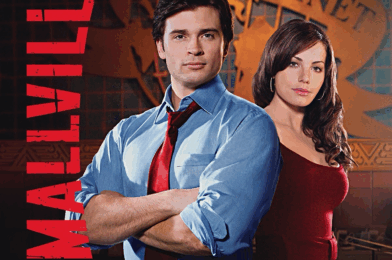
So, I did a very stupid and time-consuming thing: I rewatched Smallville. Yes, Smallville. The early 2000s WB show where Tom Welling’s Clark Kent spends ten (!) whole seasons not wearing the Superman costume. It’s a mix of teen soap, comic book melodrama, and weekly meteor-freak shenanigans. Hardly “peak TV.” And yet, watching it again, I realized something: I kind of miss the 22-episode season.

Let’s be real: Not every episode is a gem and some episodes are straight-up ridiculous. We got Bug Boy, the cheerleader with kryptonite lipstick, the guy who absorbed people through his hands, villains that would barely pass muster in a Silver Age comic. But here’s the thing: some of those “meteor freaks” were played by actors who went on to bigger things. Smallville gave early breaks to people like Amy Adams, who popped up in Season 1 as a literal fat-sucking kryptonite mutant before becoming, well, Lois Lane in the DCEU (That’s the official name?). Jensen Ackles, who later became a household name on Supernatural and The Boys, also passed through Smallville as Jason Teague, a love interest turned antagonist. The show doubled as a talent incubator in a way modern six-episode prestige dramas simply don’t. Shorter seasons mean fewer guest spots, fewer oddball roles, and fewer chances for actors to cut their teeth before they become stars. Even Evangeline Lilly appeared briefly as an extra before finding fame on Lost. The sheer volume of episodes meant there were endless opportunities for actors to pop in, experiment, and sometimes launch whole careers.

The WB’s creative team leaned hard into this format. Series creators Alfred Gough and Miles Millar knew they were making a show that was equal parts teen melodrama and superhero origin story. The early seasons had a kind of earnestness that matched the WB’s lineup (I really miss Buffy the Vampire Slayer), while the later seasons brought in more DC Comics mythology under the pens of writers who clearly loved the source material. Sometimes that love translated beautifully; sometimes it gave us Bug Boy.

And while we’re talking cast: Michael Rosenbaum deserves credit for being a genuinely good Lex Luthor. He nailed that mix of charming best friend and brooding, inevitable villain. Erika Durance, when she finally arrived in Season 4 as Lois Lane, was also a revelation. She was funny, tough, and a nice counterbalance to Clark’s brooding. Kristen Kreuk’s Lana Lang did her job well as the doomed central love interest in the early seasons, but by the time she left, it was overdue. The writers had clearly run out of ideas for her, and everyone watching knew this was always going to be Lois and Clark, not Lana and Clark.

Modern shows don’t work the way Smallville did. With six or eight episodes a season, every moment has to be a turning point, every scene is cranked up to eleven. It’s like reading a comic where every issue is a “major crossover event.” Sounds exciting, but without the quieter in-between issues, the big ones lose their impact. Smallville, goofy as it was, understood the rhythm: you need the monster-of-the-week to make the season finale matter. And even though it took ten years for Clark to officially put on the cape, you never had to wait to see him do something super. Every week had its payoff, however silly the setup.

Of course, not everything was perfect. For a show that spent ten years building toward Clark becoming Superman, the actual payoff in the last episode felt underwhelming. The writing set it up, the performances delivered, but the WB budget didn’t. We got a lot of reaction shots, some CGI cape flapping, and not nearly enough of Tom Welling in full Superman glory. It was a finale that proved how much heart the show had, but also how frustrating its limitations could be. 

Look, I know it’s a little silly to be pulling life lessons about TV from a WB show where Clark Kent fought Bug Boy. But maybe Bug Boy is the perfect symbol of what I’m talking about: silly, forgettable, kind of embarrassing—and yet essential. Without Bug Boy, the show doesn’t work the same way. He even pops back up briefly in the final season’s “Homecoming” episode, this time cured of his freak-of-the-week villain status. That moment helps Clark recognize the positive impact he’s had on the people he meets along the way. Even the silliest one-off character ends up reinforcing the bigger theme: Clark makes lives better just by being who he is. That tiny callback shows that even the most disposable-seeming characters had a place in the larger journey, and that’s the kind of breathing space television often misses today. Bug Boy is the reminder that not every episode has to be brilliant to matter. The Bug Boys of the world are what make the big moments shine. But that’s exactly why I loved revisiting it. Those sprawling, uneven 22-episode seasons weren’t perfect, but they gave characters room to breathe, they gave actors a platform to grow, and they gave us that weekly rhythm comics readers know so well: sometimes silly, sometimes epic, but always moving the larger myth forward. And honestly? That’s the lesson here for modern TV. Not that every show needs Bug Boys or kryptonite lipstick cheerleaders, but that giving characters room to stumble, breathe, and even fail in silly episodes makes the big arcs more meaningful. It’s a reminder that sometimes the imperfections of a long season create the space for genuine surprises andI strongly believe that’s what TV is missing today.

Or to put it in Smallville terms: without a few Bug Boys, you never really earn the moments that actually land. Even the clunkiest filler can make the stronger arcs resonate more. Your move Stranger Things.

Tagged : / /

Episode 79 – The Lord of the Rings

In this episode of “Passion of the Geeks”, Pat & Greg talk about the absent Boba Fett, the fun Pokemon Legends, the great Legend of Vox Machina, the amazing Nobody saves the World, the cool Star Trek models by Bluebrixx and the epic Lord of the Rings. 

Today I found out.

  • Craob X (Pat)
  • Sony buys Bungie (Greg)

Check this Out! 

  • Pokemon Legends: Arceus (Pat)
  • The Legend of Vox Machina, Nobody saves the World, Star Trek by Bluebrixx (Greg)

Story of the Week

  • The Lord of the Rings

Links & Sources

Please like, share and subscribe to “Passion of the Geeks”. We’re on all mayor podcasting services, YouTube and on www.passionofthegeeks.com

You can send questions and suggestions to passionofthegeeks@gmail.com and you can find us on twitter @passionotgeeks 

Tagged : / / / / /

Episode 78 –  Greg’s 2021 Top 10 (unplugged)

In this “Passion of the Geeks – unplugged” Greg counts down his favourite movies and shows of 2021. 

Tagged : / / / / / / /

Episode 75 – A Farewell to 2021

In this fully packed episode of “Passion of the Geeks”, Pat reviews the A500 Mini line up, Greg shares what he’s been watching and together iur fellow geeks talk about their favorite movies, shows and games from 2021.  

Today I found out.

  • A500 Mini: Game List (Pat)
  • PS VR 2 and Horizon Call of the Mountain (Greg)

Check this Out! 

  • Baldur’s Gate: Dark Alliance & Nintendo Switch N64 & Mega Drive/Genesis Emulation (Pat)
  • Ghostbusters Afterlife, Cobra Kai Season 4, Matrix 4, Book of Boba Fett (Greg)

Story of the Week

The year 2021 in review

Links & Sources

Please like, share and subscribe to “Passion of the Geeks”. We’re on all mayor podcasting services, YouTube and on www.passionofthegeeks.com

You can send questions and suggestions to passionofthegeeks@gmail.com and you can find us on twitter @passionotgeeks 

Tagged : / / / / / / / / /

Episode 74 – Streaming Roundup #3 – More Movies (unplugged)

In this weeks “Passion of the Geeks – Unplugged”, Greg recommends some more movies to watch on various streaming services. 

Tagged : / / /

Episode 72 – Greg’s Bookclub #3 – Plays (unplugged)

In this unplugged episode Greg goes full Bookclub again. This week he talks about four plays he likes to read with his students.

Please like, share and subscribe to “Passion of the Geek”s. We’re on all mayor podcasting services and on www.passionofthegeeks.com.

You can send questions and suggestions to passionofthegeeks@gmail.com and you can find us on twitter @passionotgeeks 

Tagged : /

Episode 69 – Top TV Twists

In episode 69 of “Passion of the Geeks”, Pat and Greg talk about the new Sherlock Holmes Game, Around the World in 80 Days, something very stupid a whole bunch of new shows on TV, Peter Jackson new Beatles documentary and  have a discussion about different kinds of twists on TV. In short: They have a lot of fun.

Spilers for Doctor Who, Alias, Scrubs, Babylon 5, Buffy, Battlestar Galactica, Duck Tales and The Good Place.

Today I found out.

  • Around the World in 80 Days (Pat)
  • Something very stupid (Greg)

Check this Out! 

  • Sherlock Holmes Chapter 1 (Pat)
  • The Beatles – Get Back (Greg)

Story of the Week

  • Twists on Television

Links & Sources

Please like, share and subscribe to “Passion of the Geeks”. We’re on all mayor podcasting services, YouTube and on www.passionofthegeeks.com

You can send questions and suggestions to passionofthegeeks@gmail.com and you can find us on twitter @passionotgeeks 

Tagged : / / / / / / / / /